Adding and Subtracting Fractions
Adding and subtracting fractions are governed by two simple rules.
1 - The denominators (bottom) of the two fractions must be the same.
2 - Add (or subtract) the numerators (top) and just keep the denominator.
To explain, consider
1⁄5 + 2⁄5 = 3⁄5
The denominators are the same. Therefore, just add the numerators and keep the denominator.
And the answer is three-fifths. Easy, right?
And this can be viewed graphically also.
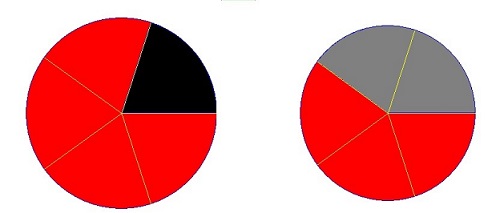
Note from the above graphic the two circles are divided into equal pieces (the denominator).
The one on the left shows a black portion of 1 of these pieces and since there are five total pieces that is one out of five (1⁄5).
Similarly the one on the right is gray and is two out of five (2⁄5).
It is key to note the two circles are divided into the same number of pieces. And, of course, these can be added as shown below. And the result is 3⁄5 (black plus gray)
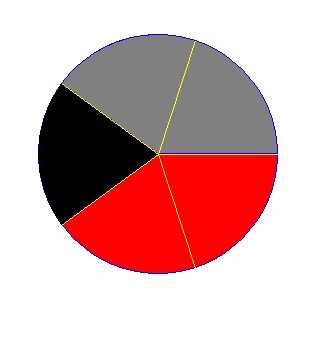
Because these two fractions (circles) had the same denominator (were broken into the same number of pieces), when they were added the "added pieces" hit exactly on a boundary. And that, of course, is because they had the same denominator.
Well, sometimes they are not that easy and we must call upon "equivalent fractions". Consider,
1⁄2 + 2⁄5
The denominators above are NOT the same, but we must make them the same. We need a competent multiplication capability to accomplish this. And we need to be rather quick and that is why we need to KNOW our multiplication facts, DEAD SOLID.
So, what are the equivalent fractions of 2/5? Well,
2⁄5 * 2⁄2 = 4⁄10
is clearly one fraction equivalent to 2⁄5.
Remember that 2⁄2 is equal to one (1) and when we multiply anything by one (1) we get that same value (but in this case it looks different).
So 2⁄5 is equivalent to 4⁄10.
And then there are more equivalent fractions using this same technique but with "different versions" of one (1), such as:
3⁄3 , 4⁄4, 5⁄5 etc
and when we multiply by these above "versions of one (1)" we get the following equivalent fractions:
     6⁄15
     8⁄20
     10⁄25
and we could go further but that is enough. Now determine the equivalent fractions of 1/2. Similarly, they are:
     1⁄2 * 2⁄2 = 2⁄4
     1⁄2 * 3⁄3 = 3⁄6
     1⁄2 * 4⁄4 = 4⁄8
     1⁄2 * 5⁄5 = 5⁄10
So, the equivalent fractions for 1⁄2 and for 2⁄5
     1⁄2
     ----
     2⁄4
     3⁄6
     4⁄8
     5⁄10
     6⁄12
     2⁄5
     -----
     4⁄10
     6⁄15
     8⁄20
     10⁄25
     12⁄30
Remember we MUST have fractions with the same denominator (bottom).
Find one fraction under the 2⁄5 and one under the 1⁄2 with the SAME DENOMINATOR.
Obviously it is 5⁄10 and 4⁄10, so now.
     1⁄2 + 2⁄5 is the same as
     5⁄10 + 4⁄10 = 9⁄10
Graphically, what happened when we "changed" 2⁄5 to 4⁄10 is shown below.
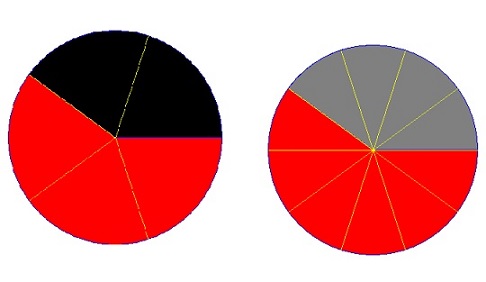
Notice that the black portion of the circle on the left is the same amount as the gray portion on the right, with the right one merely divided into more pieces. But the amount in both circles is the same.
And the reason we determine a common denominator is shown below. If we try to add one-half to two-fifths without first finding the common denominator (dividing the circle into the same number of parts) then when they are added the "added pieces" will not hit on a boundary.
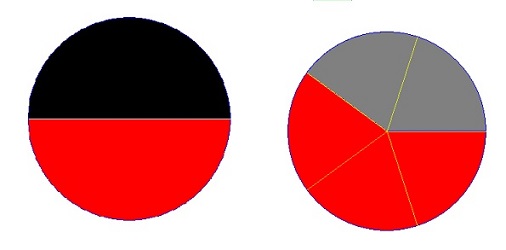
Note that the black plus gray portions of the circle (below) do NOT add together and hit a boundary of the circle divided into five parts.
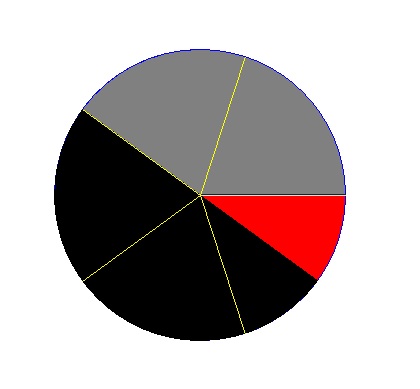
Again, it is important to note that the "added portion" does not meet on a boundary.
But if the denominators had been changed to 10 before the adding process then the "added portion" would hit on a boundary, because they had a "common denominator".
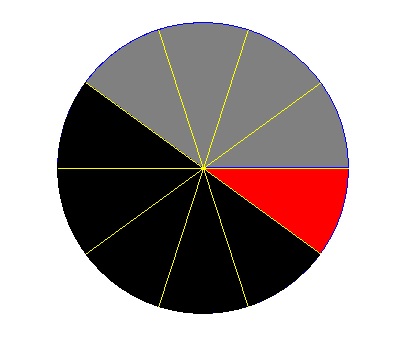
And that is the process of adding (or subtracting) fractions.
And if you go through that long thought process with every fraction you will never be very efficient at math.
So, how to get more efficient?
3⁄4 + 1⁄2
Look at the denominators (4 and 2) and think about "common multiples" and try to find one.
Multiples of 4 are 4, 8, 12, 16, 20, etc. Multiples of 2 are 2, 4, 6, 8, 10, 12 etc.
We need a common multiple. Well, 4 is common to both. MAKE THE DENOMINATOR 4 for both fractions.
Its already 4 for 3⁄4.
Make it 4 for 1/2 ... equivalent fraction of 1/2 with denominator of 4?
Multiply 1/2 by one (2/2) ... it is still EQUIVALENT to 1/2
    3⁄4 + 1⁄2 * 2⁄2
    3⁄4 + 2⁄4 = 5⁄4
So, try these ...
First, find the common denominator (using common multiples)
3⁄4 + 1⁄3
the common multiple is 12 and the answer is 13⁄12 which is improper, so 1 1⁄12
1⁄2 + 5⁄6
the common multiple is 6 and the answer is 8⁄6 which is improper, so 1 2⁄6 or 1 1⁄3
1⁄5 + 7⁄8 the common multiple is 40
the common multiple is 40 and the answer is 43⁄40 which is improper, so 1 3⁄40
19⁄25 - 1⁄5 the common multiple is 25
the common multiple is 25 and the answer is 14⁄25
3⁄11 + 2⁄11 the common multiple is 11
the common multiple is 11 and the answer is 5⁄11
10⁄11 - 3⁄4 the common multiple is 44
the common multiple is 44 and the answer is 7⁄44
3⁄4 + 11⁄12 the common multiple is 12
the common multiple is 12 and the answer is 23⁄12 which is improper, so 1 11⁄12
3⁄4 + 1⁄5 + 1⁄10
the common multiple is 20 and the answer is 21⁄20 which is improper, so 1 1⁄20
And now, for a tough "one more" which insures we still know how to add and subtract numbers.
-3⁄4 + 4⁄7 - 13⁄14
One thing is for certain, the least common multiple is 28. Therefore, I must get every fraction with a denominator of 28. From our knowledge of equivalent fractions:
-21⁄28 + 16⁄28 - 26⁄28
So, the real question now is what is:
-21+16-26
which is -31. So,
-21⁄28 + 16⁄28 - 26⁄28 = -31⁄28
which simplifies to
-13⁄28